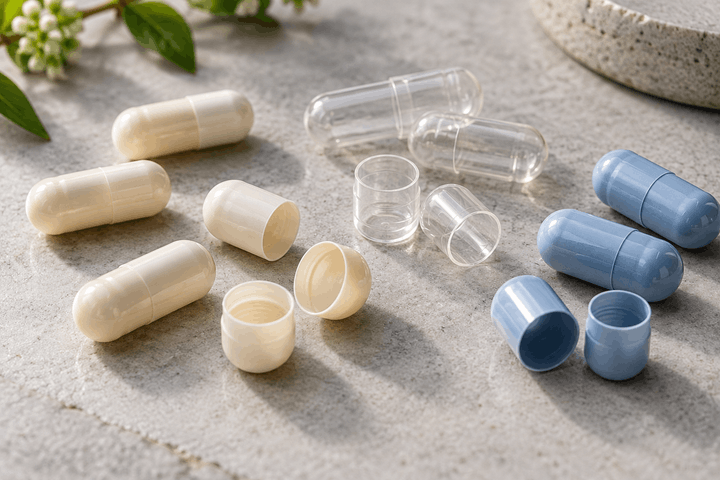
Many supplement capsules use gelatin or hydroxypropyl methylcellulose, usually shortened to HPMC, as their shell material. Pullulan is another option. The shell is distinct from the vitamins, minerals, botanical preparations or other materials placed inside it. To understand what a capsule is made of, review both parts rather than treating the whole product as a single ingredient.
For a supplement brand, shell selection affects the product brief, material documentation, appearance and compatibility questions. A transparent capsule is not automatically vegetarian, and choosing a vegetarian shell does not establish the composition of the finished supplement. This guide focuses on two-piece hard capsules and explains how to compare the materials and the evidence behind a proposed specification.
Which parts of a supplement capsule need separate review?
The shell and the fill have different specifications
A hard capsule has a cap and body that enclose the fill. The shell supplier describes the empty capsule; the supplement manufacturer defines the filled product. Ask for the shell grade, size, composition and appearance alongside the formula revision, fill target and proposed serving. These records should refer to the same development proposal.
A specification that says only “vegetable capsule” leaves important information unresolved. It may not identify the polymer, supplier grade, color system or printing. Equally, a complete shell document cannot tell you whether the fill contains animal-derived material. Keep shell and formula review connected while preserving the distinction between them.
Hard capsules and softgels are different projects
Do not use the word capsule to hide the proposed delivery format. Identify whether the project involves a two-piece hard capsule, a softgel or another specialized format. An oil-based concept may need a different assessment from a dry-powder concept. If the intended product is a softgel, start with the relevant softgel manufacturing discussion rather than selecting an empty hard shell from its appearance.
What are the main capsule shell materials?
Gelatin comes from animal collagen
The USP food-grade gelatin monograph describes gelatin as a product of collagen hydrolysis. Its animal sources include skin, bones and connective tissues, including those of fish and poultry. Gelatin is therefore not a vegetarian shell material. Ask which species and material source apply to the specific shell offered for your product.
Do not infer the source from capsule color or a general catalog description. If species origin matters to your customers, state the requirement before samples are ordered. Ask which records support the proposed source and what happens if the supplier or grade changes. A sourcing preference needs to appear in the purchasing specification, not only in marketing notes.
Review claims at the correct level
Documentation relating to a gelatin raw material, an empty shell or a manufacturing location answers a different question from documentation for the finished supplement. Identify which item a certificate or statement covers. Avoid copying a seal onto artwork because a similar capsule appears in a supplier brochure. Have the relevant reviewer confirm the proposed wording and supporting scope.
HPMC is a cellulose-derived shell material
HPMC stands for hydroxypropyl methylcellulose, a modified cellulose material. Capsugel’s technical FAQ describes HPMC shells and distinguishes its particular manufacturing system from grades that use gelling aids. It also identifies conditions involving colors and printing inks in its vegan certification. Those statements concern the named supplier’s products, not every capsule described as HPMC.
For a buyer, the practical question is which exact grade has been proposed. Request the full shell composition and the supplier’s relevant handling information. If the development sample uses an unprinted clear shell but the intended product uses an opaque printed shell, make the appearance change visible in the review. Material selection should not be separated from the finished presentation.
Pullulan is produced through fermentation
A USDA technical report on pullulan describes a carbohydrate polymer produced by microbial fermentation and discusses its use in capsule materials. This explains its origin; it does not establish that an arbitrary pullulan shell or finished product qualifies for a particular organic claim.
Ask the supplier to identify the offered grade, complete formulation and supporting documentation. If a customer requirement concerns the fermentation inputs or material origin, request a statement specific to that requirement. Treat pullulan as an option to assess against the product brief, rather than a reason to skip fill, packaging or finished-product review.

What else can be present in a capsule shell?
Check the complete formulation and appearance
The headline polymer does not necessarily describe every shell component. Request the composition of the proposed clear, colored, opaque or printed version. Ask the supplier to identify any gelling aids, coloring components and printing materials that apply to that grade. Do not assume two visually similar shells have identical formulations.
Start with the appearance your brand actually intends to use. Specify the cap and body colors, opacity, size and printing design where relevant. Give the reviewer the proposed market and any ingredient exclusions. This avoids a late conflict in which the capsule used for development is acceptable, but the final color or print proposal has not been reviewed.
Keep consumer statements precise
Terms such as vegetarian, vegan, natural and clean label raise different questions and should not be used interchangeably. State the exact claim the brand wants to make, then identify the information needed to support it. A shell-material choice can be part of that review, but it does not replace examination of the fill and other relevant inputs.
Record what may be substituted
If the manufacturer proposes an alternative shell grade, request a comparison against the approved specification. Identify composition, size, appearance, documentation and relevant compatibility differences. Decide whether another sample or further review is required before accepting the substitution. Avoid an agreement that allows any “equivalent vegetarian shell” without explaining how equivalence will be assessed.
Does shell material determine how the capsule dissolves?
Distinguish disintegration, dissolution and absorption
Disintegration concerns a dosage unit breaking apart under defined test conditions. Dissolution concerns material entering solution under a specified method. Absorption concerns what enters the body after administration. Those are connected questions, but they are not interchangeable measurements. Seeing a shell open in a glass does not establish the dissolution of the intended ingredient or its absorption in a person.
The NIH Office of Dietary Supplements discusses dosage-form characterization, including how the formulation matrix and excipients can affect release considerations. Its research guidance encourages evaluating disintegration and dissolution before interpreting pharmacokinetic or efficacy work. This supports reviewing the finished preparation rather than judging performance from the name of its shell polymer.
Ask what the proposed test actually answers
When a supplier presents a test, identify the sample, its formulation and whether it was empty or filled. Ask which method, medium and acceptance criteria were used, and whether the tested product represents your proposed formula. A result for an empty shell can be useful material information; it does not automatically settle the behavior of a filled botanical product.
Use product-specific evidence without making universal rankings
A 2020 study of green tea supplements reported differences in disintegration and dissolution and questioned whether general protocols were adequate for those products. This was laboratory work on a particular botanical category. It does not show that one shell material always performs better, or that a particular capsule produces better health outcomes.
The purchasing lesson is to specify the question before requesting a performance claim. If release behavior matters to the product concept, agree an appropriate evaluation with qualified technical reviewers. Do not add a fixed dissolving time to artwork simply because another supplier reports that time for a different shell or fill.
Similarly, avoid selecting an entire delivery format on an assumption that capsules are always faster or better. Our capsule and tablet comparison explains how manufacturing requirements and the finished serving can lead to different choices without making a universal absorption claim.
How should shell selection account for the fill and packaging?
Begin with the actual material preparation
Identify the fill clearly: ingredient preparation, carriers, supporting ingredients and any relevant material specifications. A plant powder, extract and premix with the same headline botanical are different proposals. Ask which features of the fill need assessment when selecting the shell and the manufacturing approach. Share known moisture or storage information rather than expecting the developer to infer it from a retail label.
If a raw-material grade changes, reconsider whether the shell and filled-product proposal still represent the accepted version. Keep the change assessment proportionate to the actual difference. The goal is a documented decision, not a rule that every minor adjustment requires the same amount of development work.
Review the packed product as a complete system
Ask how the intended container, closure and storage instructions fit the finished capsule requirements. Discuss these points with supplement packaging services before finalizing a bottle or pouch solely for its appearance. Review fill count, opening experience, capsule access and usable label space alongside the agreed protection requirements.
A container brochure describes a component, not your complete packed product. Record the exact pack components used for any relevant evaluation and the proposed commercial order. If a closure, liner or container size changes, make the difference visible to the people approving the product and artwork.
What should a brand ask before approving a capsule specification?
Use a concise comparison sheet rather than a collection of disconnected brochures. The following fields help the brand and manufacturer identify the same proposed product:
Include a place for open questions and their owner. A comparison is easier to act on when the approver can see which item is settled and which still needs a technical response.
| Field | Decision to record |
|---|---|
| Shell identity | Polymer or gelatin source, supplier grade and full composition. |
| Appearance | Size, cap and body colors, opacity and any printing. |
| Fill identity | Formula version, material preparations and intended serving. |
| Compatibility review | Questions assessed, available evidence and remaining conditions. |
| Packaging | Container, closure, count and relevant storage instructions. |
| Change control | Who reviews substitutions and what records stay linked. |
A hypothetical brand comparing a clear gelatin capsule with a colored HPMC capsule should not attribute every difference to the polymer. The proposals also differ in color system and possibly the supplier grade. First identify which choice the comparison is intended to resolve. Then decide which features should remain constant and which need separate review.
Use the capsule manufacturing brief to connect the shell proposal to filling and finished-product requirements. If the formula is still developing, identify open choices through formulation review before presenting the shell selection as final.
How can you compare capsule samples before committing?
Use a record that identifies the whole proposal
Give each sample a code and record its shell grade, color or printing version, fill formula and pack reference. Ask which items are representative of the intended commercial product. A sample may be useful for checking color or capsule size even when the final fill is not ready, provided that limitation is clear. Do not allow an approval for one feature to become approval for the entire product.
Review visible appearance, capsule integrity and practical access from the proposed pack. Record observations with the sample code rather than assigning a pass or fail without a specification. For example, if the brand wants a consistent opaque presentation, note whether the samples match the agreed reference. Do not use that visual observation to infer the shell material or analytical quality of the fill.
Distinguish observations from technical conclusions
A sample looking unchanged after storage on a desk is an observation, not a complete stability conclusion. A capsule opening in a drink is an observation, not a standardized release test. Record the conditions and let the technical reviewer decide whether they answer a relevant development question. Keep informal demonstrations separate from the evidence used to support a product specification.
Check size, fill and count together
Ask the manufacturer to evaluate the actual blend in the proposed capsule size. Do not convert a nominal shell size directly into a promised ingredient weight without that assessment. Record the intended number of capsules per serving and per pack so that the shell choice remains connected to the customer’s finished product rather than an isolated component purchase.
Consider a hypothetical buyer who prefers a smaller capsule but also wants fewer capsules per serving. These preferences may conflict for the proposed formula. Request a clearly described alternative and decide which requirement can change. The comparison should show the finished serving and pack count, not just two empty capsules placed beside each other.
Which documents should remain linked to the approved shell?
Keep material evidence separate from batch evidence
Retain the approved shell specification, supplier identity, relevant origin or composition statements and the appearance reference. Connect them to the fill formula and product revision. When reviewing a report, establish which sample or lot it describes. The guide to reading a supplement COA explains why an ingredient or component report cannot simply be treated as a finished-batch report.
Reconcile the label before printing
Give the label reviewer the final shell and fill information rather than only the front-pack concept. Check that ingredient declarations and any relevant product statements reflect the version being ordered. Use the supplement label preparation checklist when an appearance or composition change affects the artwork. Preserve the reviewed version for repeat orders.
Capsule material questions
Are supplement capsules made of plastic?
The common shell options discussed here are gelatin, HPMC and pullulan. A smooth or glossy surface does not identify the material. Check the proposed composition and ingredient declaration instead of guessing from a photograph. The term polymer describes a broad material structure; it does not make every polymer the same substance.
Does a vegetarian shell make a supplement vegan?
No. Review the fill, shell components, printing materials and other relevant inputs against the intended statement. A document covering an empty shell does not automatically certify the complete supplement. Ask who is responsible for reviewing the final claim and what evidence they need.
Can I open the capsule and use only the powder?
This guide addresses product development, not directions for changing how an individual supplement is used. Follow the product’s instructions and obtain appropriate professional advice where needed. A brand intending an opened-capsule use should define that requirement during development and have the complete product and directions reviewed.
Which shell should I choose for my brand?
Choose after comparing the formula, material requirements, market, appearance, available evidence and packed-product brief. Review capsule product concepts to identify the relevant format, then request an assessment of the particular formulation. There is no useful universal answer based on shell material alone.