To make a supplement label, begin with approved product information and the market where the product will be sold. Then organize the required statements, prepare the artwork for the actual container, and complete a controlled review before printing. A polished bottle mockup cannot supply the missing formula, serving basis or claim review.
This guide focuses on US dietary supplement labels and the practical handover between a brand, manufacturer, reviewer, designer and printer. It is a project checklist rather than a universal label template. Requirements depend on the product and proposed statements, so assign the relevant review before ordering printed stock.
What should you confirm before a designer starts the label?
Establish the product category and destination market first. A supplement label should not be copied from a conventional beverage or an unrelated product just because the pack has a similar shape. Confirm the intended product description, customer, formula version, serving directions and finished pack quantity before treating a reference image as a design brief.
Give the designer a controlled information sheet. Include approved ingredient names, forms and quantities; other ingredients; serving information; net contents; business contact details; required warnings or other statements identified by the reviewer; and the proposed marketing wording. Mark unapproved fields clearly. The designer should not have to invent technical information to complete a balanced layout.
Connect the formula, specification and artwork
A product may have several working documents during development. Choose the approved formula and specification that the label will describe. Record their versions alongside the artwork brief. If the manufacturer changes a material preparation, flavor system or serving format, route the change back to the people reviewing the label.
When custom formulation work is still active, final printing may be premature. A designer can develop the visual system while technical details remain open, but the file should stay identifiable as a working proof. Do not let a presentation deadline turn placeholder information into approved production copy.
What basic information belongs on a US supplement label?
FDA’s general dietary supplement labeling guide identifies five basic statements: product identity, net contents, nutrition labeling, ingredient information, and the name and place of business of the manufacturer, packer or distributor. The guide also addresses placement and readability. These basics are a starting point, not a complete assessment of every product and claim.
Separate the front presentation from the information needed for review
The front of the pack usually carries the strongest brand and product presentation. Decide which proposed wording is descriptive and which communicates a claim. Keep a written explanation of unfamiliar names and abbreviations. Decorative prominence should not make required information difficult to find or create a product impression that the approved specification cannot support.
On the information areas, give the reviewer enough room to assess the required content and relationships between statements. Avoid designing around an assumed quantity of text and then shrinking the type when the real information arrives. Ask the reviewer and printer about applicable layout constraints before the visual design becomes difficult to change.
Check business and contact information carefully
Confirm the correct legal business details and the role represented on the pack. Review FDA’s current supplement questions and answers for label information, including the domestic contact provision for reporting serious adverse events. Do not use a generic supplier address simply because it appeared on a sample bottle.
Assign an owner to maintain the contact information. If a brand changes its address or customer service arrangements, the label file and supporting information need review together. A functioning company website does not automatically resolve whether the package contains the information required for the product.
How do you prepare the Supplement Facts panel?
Work from the approved product and serving basis. Current 21 CFR 101.36 covers serving information, dietary ingredient declarations and Supplement Facts formatting provisions and exceptions. Use the applicable current requirements with the label reviewer rather than copying a competitor’s panel or an outdated example.
Make the serving basis consistent across the pack
Compare serving information with the directions, ingredient declarations and pack quantity. A formula amount per capsule is not the same expression as an amount per serving when the serving includes more than one capsule. For powder, connect serving weight, the stated net contents and the declared servings per container using the approved information and applicable rules.
As a hypothetical review exercise, imagine that a brand changes the serving instructions after sample approval while the designer keeps the old panel. The bottle count may remain unchanged, but the serving information no longer describes the same product presentation. The correction begins by resolving the intended serving, not by adjusting isolated numbers until the layout looks plausible.
Do not confuse ingredient forms with declared nutrient amounts
Ingredient documentation may describe a compound, extract preparation or supplied premix. The information needed for the label may be expressed on a different basis. Ask the qualified reviewer to reconcile the approved formula, supporting records and proposed declarations. A buyer should not convert a supplier’s specification into label copy using an unexplained spreadsheet.
Keep carriers and other supporting ingredients visible in the source file
Ask for the full relevant ingredient information, including materials that may be easy to overlook when a supplier describes only the headline active ingredient. The reviewer needs to know what is present before deciding how the final ingredient statements should read. A short marketing ingredient list should not replace the formula information supplied for review.
For botanicals, resolve the identity and preparation details required for the intended declaration. A familiar common name can conceal different source materials or preparations. Keep the terminology consistent between the approved specification, panel and other label text so a single product is not described in conflicting ways.
How should you review claims before putting them on the label?
Create a claim list separate from the design file. Include product names, benefit phrases, badges, footnotes, images and any comparison wording. Identify the evidence and review decision for each proposed statement. This makes it easier to see which phrases are approved, which need qualification and which should be removed before the printer receives the artwork.
Classify the proposed claim before choosing its wording
FDA’s structure/function claims page explains substantiation, disclaimer and notification requirements for the covered dietary supplement claims. Do not assume that a disclaimer makes any proposed statement acceptable. Route wording that suggests disease treatment or prevention, or another regulated claim category, for appropriate review before approval.
Be specific about what the statement describes. An ingredient’s published research, a raw-material assay and a finished-product claim are different forms of information. Ask whether the support relates to the actual preparation and product presentation. A designer should receive approved wording, not a request to make an unreviewed promise sound less explicit.
Review the impression created by words and images together
The FTC’s health products compliance guidance discusses express and implied advertising claims and the evidence supporting them. Review how the product name, graphics and surrounding copy work together. A phrase that seems restrained in isolation may communicate something different beside a strong visual or testimonial.
Keep the approved message consistent across the label, website, advertising and retailer materials. If a distributor rewrites a product description, ask whether it still reflects the review. A carefully prepared package does not prevent an online listing from introducing a separate unsupported claim.
What should you check on the physical print proof?
Review the label at actual size on the intended container or an appropriate physical mockup. A large screen rendering can hide small type, awkward seams or information that falls around a curved surface. Confirm the label dimensions with the packer and printer rather than measuring an unrelated bottle photograph.
Check container fit and usable space
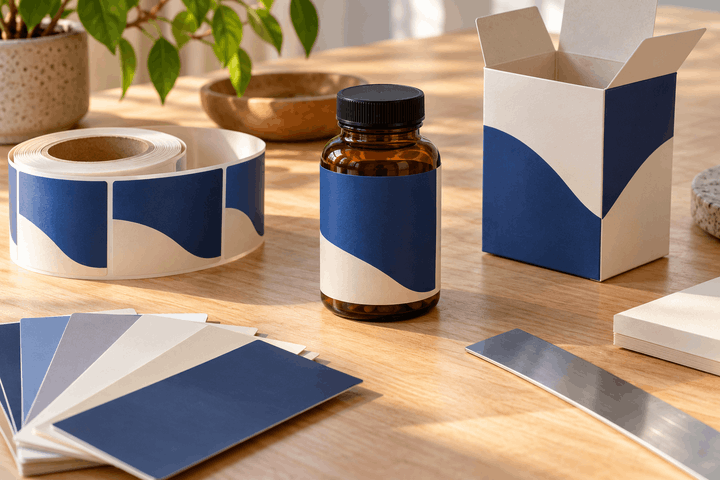
Confirm the container, label area, orientation, overlap or gap, and any areas reserved for production coding. Review how the label sits near shoulders, curves, closures and pack seams. For a pouch or carton, use the correct approved dieline and check which surfaces remain visible after sealing, folding or assembly.
Keep required information clear of production features
Ask the printer and packer where cuts, seals, folds and coding operations occur. Check whether those features affect the reviewed information. The point is to prevent a technically complete digital file from becoming difficult to read or partially obscured after application to the real pack.
Through supplement packaging services, coordinate the product, container and print material as one project. Confirm the proposed stock, adhesive or printing approach with the relevant suppliers. Review the practical fit and handling of the final combination rather than treating packaging appearance as the only approval criterion.
Check production details and artwork integrity
Review the barcode requirements with the relevant channel and verify that the supplied artwork preserves the correct data. Confirm product and variant names, count or net contents, language version, business details and coding space. Ask the printer to explain any prepress changes that affect the approved layout or text.
Keep a readable proof with the approval record. When a file is converted, resized or prepared for print, compare the resulting proof with the approved version. Do not assume that the presence of the same filename means that all wording, symbols and line breaks remained unchanged.
Who should approve the label before it is printed?
Name the reviewers and their responsibilities. The brand approves the commercial identity and intended messaging. The relevant technical and regulatory reviewers assess the product information and market requirements. The manufacturer or packer checks the connection to the product and production arrangement, while the printer reviews the print file and process requirements.
Agree this handover within the private label project and manufacturing scope. A general email saying “looks good” may refer only to color or appearance. Ask reviewers to state which version and which aspects they are approving, with outstanding conditions listed separately.
Use one final approval record
- Product identifier and approved formula or specification revision.
- Artwork filename, version and intended market or language.
- Container, label size, count or net contents and relevant pack components.
- Reviewers, approval dates and any conditions that must be closed.
- The exact final proof authorized for printing.
After approval, control changes through the same route. Even a correction that seems small can affect another field or a layout requirement. If the designer moves text to make room for a new claim, review the changed proof rather than relying on approvals given before the alteration.
What changes require the label to be reviewed again?
Start with changes to the formula, ingredient source or preparation, serving, pack quantity, business details and proposed claims. Ask the responsible reviewer whether the change affects the label. Keep the product change record and artwork decision connected, even when the conclusion is that no visible text needs alteration.
Variant management deserves particular care. A new flavor may change supporting ingredients or the product description. A new bottle size may change the physical layout and pack quantity. Similar packaging can make the wrong file look convincing, so identify variants by controlled product and artwork codes rather than color alone.
A hypothetical powder-label change
Suppose a brand develops a second flavor of an electrolyte powder product. The team should review the actual new formula, serving and pack, then identify the label changes required. It should not merely swap the flavor name on the previous print file. This is an illustrative workflow, not a statement about a specific available formula or ingredient amount.
Ask what happens to printed stock for the previous version. Decide whether it remains usable, needs separate identification or must be held pending review. Settle that status before a busy production team has to choose between two similar rolls of labels. Record the instruction clearly with the order.
What belongs in the final artwork handover folder?
Keep the reviewed source information, final approval proof and print-ready file identifiable as different documents. The source information explains what the pack should say. The proof shows the wording and layout that were approved. The print-ready file is the production asset prepared for the agreed printing process. One should not be silently substituted for another.
Record who holds the editable artwork and any associated assets needed for future changes. Clarify access and ownership with the designer or supplier before a reorder becomes urgent. A brand that receives only a low-resolution mockup may have difficulty preparing a corrected print file without rebuilding work.
Review an applied sample when it is available
Check the printed result on the intended package, including the information around the back or side. Compare it with the approved proof and inspect whether application, folding or coding obscures anything. Route discrepancies to the relevant owner instead of accepting a change simply because printing has already occurred.
Give the receiving or packing team enough information to distinguish the correct stock. Identify product, variant, artwork version and the intended component. Similar-looking labels for different pack counts can be harder to distinguish than completely different brands. A clear inventory description helps the approved file remain connected to the physical labels being used.
Update product images and sales information together
After an approved change, check which customer-facing materials still show the previous pack. Product photographs, retailer data sheets and downloadable information can outlast an artwork revision. Decide what needs replacement and retain an archive so staff know which information belongs to each version. This prevents a carefully reviewed label from being undermined by an outdated sales presentation.
Supplement label questions before printing
Can a designer make a complete label from a reference bottle?
A reference can help communicate visual preferences, but the designer still needs approved information for your product and market. Do not copy another brand’s ingredient declarations or claims. First settle the private label responsibilities, including who provides and reviews the technical source information.
Can I copy a COA result into Supplement Facts?
Only after the appropriate review connects the measured attribute and reporting basis to the intended declaration. A raw-material result does not automatically become a finished-product amount per serving. The COA reading guide explains why sample identity, methods, units and limits need to stay together.
Is a label ready when all reviewers have seen a mockup?
Seeing a mockup is different from approving the final print proof. Close unresolved fields, confirm actual dimensions and identify the precise version authorized for printing. Keep that proof with its product specification so a reorder does not depend on a screenshot or a presentation file.
When should a gummy brand begin label planning?
Start collecting the information and market requirements during product development, while keeping final declarations linked to the accepted product. The gummy manufacturing guide shows how formula, piece size, serving and pack decisions connect. Finalize the artwork after the information it describes is settled and reviewed.